Powered By Blogger

Monday, April 5, 2010

Rediscovered Negatives: Los Colores de Coahuila

Ruta Fiscal 57, near Progreso, Coahuila, November 2007


Mexicans have a sophisticated way of appreciating color, by integrating it with buildings' architecture, in this case a bodega.  A common sight throughout the country, houses and businesses transformed into billboards make even the simplest of structures appear warm and inviting.  This yellow/white/red color scheme is emblematic of Carta Blanca beer.

Sunday, April 4, 2010

Happy Easter

U.S. Route 181, Floresville, Texas, April 2002

Easter is a time of resurrection and spiritual renewal.  Which reminds me:  I have a 1967 Plymouth Belvedere in the garage that needs some renewal before it's road ready.  I need to flush and replace the coolant, juice up the tires, change the oil, and give it a tune-up.

But first, to spend the day with my kids on a long bicycle ride and picnic at the park in Pine Island.  It is a great time to take up those New Year's resolutions we dropped, and mine is to spend as much time with my kids as I can.

Saturday, April 3, 2010

Rediscovered Negatives: Los Colores de Coahuila


Sabinas, Coahuila, April 2002


This photograph of a well-worn -- but still very sweet -- 1964 Plymouth Valiant was featured in Los Colores de Coahuila on my defunct website, which due to the vagaries of the buyout of FlashNet by Prodigy, the buyout of Prodigy by SBC Global, and the buyout of SBC Global by AT&T, has become impossible to remove my primitive and outdated site from the Internet -- whenever I telephone the customer service people at AT&T, they never even heard of FlashNet, nor have the faintest notion whom I should call, as we cancelled our FlashNet account in 2004.

Still, I love the juxtapositions of color from this print:  Deep aquamarine blue against pale salmon, and loam green and golden amber competing for the eye's attention.

Friday, April 2, 2010

Rediscovered Negatives: Los Colores de Coahuila

Villa Hidalgo, Coahuila, April 2001

Villa Hidalgo is a small hamlet near the Colombia border crossing, just north of Laredo, Texas.  I had visited Piedras Negras and Sabinas earlier in the week, and ran through about twenty rolls of film.  For this project, I was using Agfa's high-sautration HDC, Vista, and Optima II print films.  I ran out of film prior to visiting Villa Hidalgo, and found some store brand film at a Pemex convenience store on the way back towards the border (Pemex is the national chain of petrol service stations in Mexico).  

I got such beautiful results with this film, I was simply astonished at the brilliance and saturation of the colors, as well as the over luminance of the resulting prints.  On the box, it stated it was made in Italy, and after some research I found that the company that manufactures this film is Ferrania.

One of the joys of being a film photographer is that trying out a new roll of film, never before used, is always an event.  Even today, while digital photography rules the roost and all experimentation with an image takes place on a computer screen, new emulsions are issued periodically, and I'm always first to try them out.

Thursday, April 1, 2010

Kitties


Tommy and sister Nernie, Bowie, Maryland, 1974

The essence of every photograph, if it is to appeal to the emotions, is that it is a snapshot. Here is a snapshot I took when I was nine, of my Maine Coon cat, Tommy, and his grey-haired sister, Nernie.  I was surprised at how patient they were with me.  Posed though it is (and nicely so), it remains a snapshot.  Thus, it is not "real" nor "art."

When people with cameras decide to get "serious" about the photography craft, they are imb(r)ued with the sotto voce instruction that they must undo everything they have hitherto learned and practiced about photography.  "Snapshot" thus becomes the dirtiest of all sobriquets, and the newly-minted "fine arts" photographer instead shifts all his focus toward making "clever" images that are fraught with "irony."  "Irony" is code language for "I am more hip and sophisticated than thou."

One positive side-effect of the digital photography craze is the reemergence of the snapshot, that impromptu photograph taken and enjoyed for its own sake.

So, enjoy!

Wednesday, March 31, 2010

Rediscovered Negatives: Los Colores de Coahuila

Piedras Negras, Coahuila, March 2000

This photograph is from one of my first excursions into Coahuila, in the border city of Piedras Negras.  It incorporates two of my favorite subject matters for photography: Peeling paint and telephone lines.  This mural advertisement was found on the side of an abandoned car repair garage, and if you look closely, you can make out that it is for Castrol GT motor oil. I think.

Monday, March 29, 2010

Rediscovered Negatives: Los Colores de Coahuila

House entrance, Monclova, Coahuila, March 2008

This photograph was from my last excursion into Mexico before moving to Minnesota later in 2008.  Even on the cloudiest of days, the expressive facades of houses in Coahuila brighten up the day.  Homeowners' associations haven't really caught on in Mexico, save in the gated communities retired Americans move to.

Rediscovered Negatives: Im Augenblick

Flatbush Avenue at night, Brooklyn, New York, 1988

An artist friend emailed me recently, commending my photograph of the tire shop in Pixley, California I had taken with my cell phone camera.  As she is an accomplished artist, I was very pleased to have received the compliment.

The bane of most photographers' existences -- unbeknownst to them -- is that the more advanced they become (either aesthetically, or in the business) the more they let themselves be enslaved to the superior technology of their expensive camera gear.  Over time (and I am not exempting myself from this observation), their work becomes slick, but stale.  All the oomph has been taken out of it as they've progressed from Pentax K-1000 to Nikon FM-2 to whatever the hell digital camera kit with the bells and whistles people use nowadays.

The cameras to which I am most enslaved are the Rolleiflex SL-66 and Nikon FM-3A.  So, when I get into a compositional rut, I head out with the Polaroid Colorpack III, a disposable camera from Walgreen's, or my camera phone.  When one's tools are primitive, the photographer must exercise his creative mind fully to overcome his camera's flaws.

When I took this photograph, in 1988, it was with 110 film on my Kodak Ektralite 10 camera -- a pocket camera that makes photos roughly the size of 16mm movie frames.  My mainstay on a student budget was the Ricoh KR-5 Super 35mm SLR.  But it was the Ektralite that kept me "honest."

This image can be found in much poorer quality on my website, but last year I finally found the negative, hiding in a box of letters.  I was quite pleasantly surprised at the quality of the Verichrome Pan negative exposed on such a cheap camera.

Sunday, March 28, 2010

William Mortensen, 1897-1965

c. 1930s

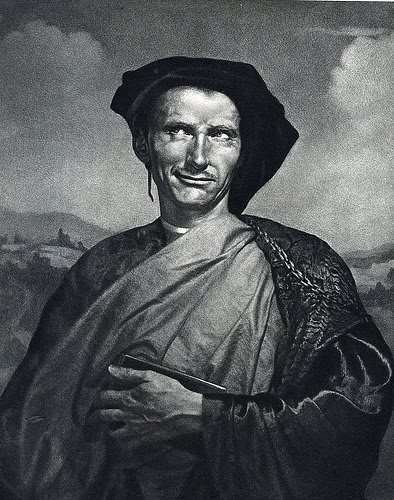
The late William Mortensen was, by the time of his death, a largely forgotten figure in the photographic world.  Along with Baltimorean A. Aubrey Bodine, Mortensen was the last great exponent of Pictorialism:  A painterly school of photography that was supplanted in the late 1920s and early 1930s by the purism of such masters as Edward Weston and Ansel Adams.

Mortensen's particular style was an admixture of Bernini, Goya, Poe, and Morticia Addams, but never came across as hodge-podge.  In the early 1930s, his Los Angeles studio boasted such luminaries as Marlene Dietrich and Fay Wray, but it was Mortensen's grotesqueries and lurid pin-ups for which he would later be remembered.

Mortensen's longtime friend and colleague
George Dunham as Niccolo Machiavelli, 1935

 No less a luminary than Ansel Adams launched a smear campaign to destroy Mortensen -- and succeeded.  Adams bristled at referring to him by name, calling him only "The Anti-Christ."

Fitting with his dark aesthetic, however, Mortensen would have the last laugh -- from the grave.  In death, Mortensen would become hugely influential on today's Gothic art renaissance. 

The Pit and the Pendulum, after Poe, 1934

For further reading on Mortensen, I commend to readers Larry Lytle's excellent piece, "The Command to Look," Carey Loren's reflections on Monsters and Madonnas, as well as my articles on photo.net and my website.

Saturday, March 27, 2010

Rediscovered Negatives: Im Augenblick

U.S. Routes 180 & 62, Seminole, Texas, November 2007

This defunct drive-thru window was outlasted by the roll of Kodak Panatomic-X 32 ASA film on which it was captured.  Over the years, I acquired quite a stock of this beautiful fine-grain black-and-white film.  The owners before me kept it in the freezer, and so did I upon purchase from eBay.  This particular roll of film "expired" in May, 1969 (which means it was probably manufactured in May, 1966 -- when I was but a baby boy of one!), but was not exposed until late 2007 and developed just yesterday.

I wonder how many "memory sticks" and cards will survive that long. (/sarcasm).


Friday, March 26, 2010

Hasselblad Xpan

Santuario Chimayo, New Mexico, June 2006

This photograph was made on the Hasselblad Xpan, a camera that makes panoramic photographs on 35mm film.  While most 35mm panoramic cameras simply pare down the height of the negative (resulting in a compressed image size on the film), the genius of the Xpan is that it expands the width of the film, making for an image size of 24x65mm.  It thus  turns a 35mm camera into a veritable medium format camera, its frame the exact same size as Paramount's VistaVision widescreen format.  

Click on the photo to enlarge.

Thursday, March 25, 2010

Rediscovered Negatives: Im Augenblick

U.S. Route 87, Swisher County, Texas, November 2004

File this photograph under the category of "commercial archaeology."  Thousands of miles of telegraph wires still follow the railway lines of the United States.  Out of use and out of order, the wires snag between poles, while other wires have long ago gone missing -- probably recycled to fund some vagrant's meth lab.  

Time was when every railroad station had a Western Union telegraph agent, who would round out messages for businessmen, police, and family members to send up the line and across the country, and even the world.

Railroads stopped using them decades ago as they switched over to radio communications.  Yet, the ubiquitousness of railroad communications networks was such that they once connected an entire continent with itself and the rest of the world.  One such carrier is still known to millions of (frustrated) customers this very day as Sprint -- the former Southern Pacific Railroad Internal Network Telecommunications.  

This particular photograph was printed from the extreme fine-grain Efke R25 film.  Though this roll has been in the freezer almost six years, upon development it still produces the sharpest images I've ever obtained from the Rolleiflex SL-66 camera.

Requiescat In Pace

Johnny Cash at San Quentin Prison.
Photograph by Jim Marshall, 1969

Another great photographer has been called home,  Jim Marshall (1936-2010).  His fame peaked in the late 1960s to early 1970s, as a photographer of the music scene whose portraits of such rock legends as Jimmy Page and the Beatles were as iconic as photographs of Annie Leibowitz or Linda McCartney.

Read his obituary here.

Hope they got Tri-X up there, dude, because you can't hardly find it down here.

Wednesday, March 24, 2010

Camera Phone Heresies

Pixley Tire Shop, Pixley, California, November 2009

I pulled off California State Highway 99 to photograph this tire shop.  Tire shops and corrugated metal have always held a special fascination for me.

At that particular time, I was using my Nikon FM-3A (the last generation of the famous Nikon F/FM series professional manual camera bodies), which was loaded with Kodak Tri-X.  Having exposed the last frame, I was about to return to my car when this little boy happened by.  

Thinking on my feet, with no time to reload, I took my Motorola cell phone from my pocket and snapped this picture up.

Now, anyone who knows me will tell you my deep-seated loathing for digital photography.  To me, it's cheating -- damned if I'm going to just flush thirty-plus years of acquired knowledge of real photography down the drain just because somebody invented a way to mimic photography.

But, as Ralph Waldo Emerson said, "A foolish consistency is the hobgoblin of little minds."  Which means, don't let a great photo opportunity pass you by just because you're a retrograde purist (such as I) standing on ceremony.

Saturday, March 20, 2010

Love Letter, Straight From My Heart

Actor, painter, photographer, director, and
all-around Renaissance Man, Dennis Hopper

The sheer heft of Dennis Hopper's latest photography book, Photographs, 1961-1967, makes this 530-page volume worth the $700 price tag (now marked down to $465.11).  I got it in the mail from amazon.com, and ensconced in a sturdy blue-linen box, it's bigger than a Guttenberg Bible.

As well it should be, given its over-the-top subject.  With essays by Jessica Hundley, the late Walter Hopps and Hopper's gallerist Tony Shafrazi, a portrait of Hopper the crazed genius comes through. Hopps's introduction, The Taos Incident, sets the stage for the kaleidoscopic imagery that follows, with his account of a visit to Hopper's New Mexican abode sometime during the 1970s.  During that trip, the purpose of which was to retrieve contact sheets and negatives for an upcoming retrospective, Hopps arrived in the midst of one of Dennis's manic episodes, riddling the walls of his own living room with a submachine gun.  

Photographer and painter Ed Ruscha, 1964

This is no "vanity" project by an otherwise marginally-talented celebrity.  Hopper was trained as an Abstract-Expressionist painter by no less than Thomas Hart Benton.  Hopper applied his aesthetic training and instincts to photography when he was given a camera by friend and acting mentor James Dean during the filming of George Steven's 1956 epic, Giant.

Hopper went crazy with the Nikon, and went through hundreds of rolls of Kodak Tri-X, particularly during the 1960s, when he was more-or-less exiled from Hollywood because of his bad boy reputation.  Many of the photographs printed herein are candids, as well as surrealistically-composed shots of showbiz friends and colleagues, such as Tina and Ike Turner, John Wayne, Peter and Jane Fonda, and denizens of the L.A. art scene like Shafrazi, Ed Ruscha and Andy Warhol.  But what really makes his style gel are his gritty and straightforward black-and-white documentary shots of urban Los Angeles.

New York City, c. 1963

Hopper's exacting eye takes us on excursions across the United States, and especially to south of the border, into Tijuana.  His Mexican photographs are his quietest, and most poignant.  Hopper's images of rural and railroad scenes in the Mexican state of Durango alone make for a remarkable monograph of photography that transcends its travel and tourist origins.


Robert Fraser, Tijuana, 1965

If your coffee table is sturdy enough to accommodate this giant tome, I recommend gracing it with the most crucial period of this larger-than-life icon of the 1960s avant-garde art scene.  Dennis Hopper's work is both entertaining and enduring, and belongs on the same book shelves with such kindred spirits as Garry Winogrand, Louis Faurer, Weegee, Diane Arbus, and Robert Frank.


Painter James Rosenquist, 1964

Visit Taschen's website to view a PDF of this fascinating book.