Powered By Blogger
Showing posts with label ricoh kr-5 super. Show all posts

Monday, December 15, 2014

What's In A Name


Berlin, West Germany, July 1987


Ricoh KR-5 Super / Rikkenon 50mm/f2

Agfachrome 100 film


When you walk into a store like Kroger, or Wal-mart, or any other store that has been built from the ground up by a family and bears the family name, you probably don't really think about the history. This is especially true in America where stores like that don't bear deep emotional scars such as this one in Berlin.


Behind the name Leiser is a history of determination, struggle, success, triumph and heartache all wrapped into one. The Leiser family was a Jewish family in the early 1900's who started their shoe company from the ground up. They became one of the most successful businesses in the area until Hitler and the S.S. finally forced them to sell off completely to Nazi run German government.


What a sign such as this that speaks volumes to the people who know its story. That through the destruction and through the history of all that happened, the name lives on and the sign, while such a simple thing, serves a reminder of perseverance and family.

Sources


Thursday, April 18, 2013

Ektachrome, Requiescat En Pace

Bathhouse, Coney Island, 
Brooklyn, New York, November 1988

Richoh KR-5 Super / Rikkenon 50mm/f2
Kodak Ektachrome  200 reversal film 

The Eastman Kodak Company, which operates on the business model of leaving their most loyal customers - i.e., film photographers - high and dry, while rolling out slipshod products in their never-ending quest to play catch-up in the digital photography arena, apparently got rid of Ektachrome, it's line of E-6 reversal films, that have been the poor relations to their proprietary process, Kodachrome, which they killed off (amid gnashing of teeth, wailing, and spinning Paul Simon's 45 record of the same name) in 2009.

But, unlike Kodachrome, the demise of which was known to film lovers well in advance, it appears that Ektachrome has gone out not with a bang, but a whimper.

The whimper came - at least to me - when I tried ordering some at B&H Photo and Video, and noticed only a few available rolls, in off-sized (such as hand-spooled 620).  I Googled Ektachrome, and found this on Eastman Kodak's website:

As of March 1, 2012, Eastman Kodak will no longer manufacture Ektachrome reversal film.

Well, then.  I guess that's that.  It looks as though Fuji and Agfa (reorganized after it spun off from Agfa-Gevaert as Agfa Photo) are the last men standing.  And, judging from the "Made in Japan" notation on the box of Agfa CT Precisa 100 I got last month, it appears that Fuji is the only manufacturer left in business.  And, even they have been winnowing down their selection of reversal films.

Thank God my Frigidaire is in good repair.

Saturday, October 13, 2012

Howard Johnson's, Harrisonburg, Virginia

Howard Johnson's Restaurant and Motor Lodge, U.S. Route 11, Harrisonburg, Virginia, June 1991
The iconic orange roofs of Howard Johnson's restaurants and lodges were once ubiquitous across the United States and Canada.  

Now, the motel chain is but a faint shadow of its old self, the poor relations in the Wyndham hotel consortium.  As for the restaurants, they have all but disappeared. There is now only one of the HoJo Restaurants left in operation.

But in 1991, which does not seem so long ago, there were still dozens of restaurants left in operation. This is a premier example.

Saturday, October 6, 2012

Kodak Ektar 25

Erika Gross, Sharpsburg, Maryland, 1988  
When we left Shepherdstown, West Virginia - just five miles away - the sun was high in the sky, though it appeared a storm was coming in on the edge of the horizon.

Less than ten minutes later, these black clouds came rolling in, and transformed the construction site at which we were shooting into a setting for great visual drama.

For once, foreboding clouds were harbingers of an unforgetful composition, instead of a washout.

Tuesday, March 20, 2012

Los Colores de Coahuila to Open in Del Rio, Texas

Piedras Negras, Coahuila, Mexico, March 2001

I am pleased to announce my first solo photographic exhibition in nine years.  My pictorial series on the frontier Mexican state, Los Colores de Coahuila, will be opening at the Firehouse Gallery in Del Rio, Texas, for their First Friday series, Friday, April 6, 2012, from 7 until 9 p.m.

Los Colores de Coahuila features 42 color photographs taken between 1999 and 2007, in locales such as Piedras Negras, Jimenez, Ciudad Acuña, Sabinas, Nava, Guerrero, and Villa Union. 

Exhibit information:

Los Colores de Coahuila
Photographic Exhibition
First Friday, April 6, 2012
7 - 9 pm
Firehouse Gallery

120 East Garfield
Del Rio, Texas 78840

(830) 775-0888

www.robertjonesphoto.blogspot.com
   

Thursday, March 1, 2012

Revisiting Old Negatives

Street scene, Lisbon, Portugal, November 1986

I took this photograph in Lisbon in November 1986, and never knew until now I took this. I had hand-developed these York Color labs C-41 negatives (rebranded 3M film), and never made a contact sheet. Then, tonight, looking through my old print files, I looked at this on the light table through my loupe, and realized I had something. Thanks to Lightroom and Color Efex software, I was able to pull a lot of color out of it. 

Sunday, January 15, 2012

Los Colores de Coahuila

 Dam reservoir along the Rio Grande
Presa La Amistad, Coahuila, Mexico, April 2001

The one thing I learned from A. Aubrey Bodine's spectacular photography of Baltimore and Maryland's Eastern Shore, is that a great photographer can never leave home, yet show us the world.  I have been in Minnesota three years, and still I cannot develop an affinity for the place.  (That's not to detract from Minnesota as photographic subject - Chris Faust has done wonders with the Gopher State).

This is where my heart is, the Mexican state of Coahuila.

I shot this exposure on one of the greatest films ever, Kodachrome 64.  Sadly, it is gone now.  
 

Friday, January 13, 2012

The Shape of Things To Come

 Parachute ride, Coney Island
Brooklyn, New York, November 1988

I don't plan on dying like Eggleston, with more than 1,000 rolls of exposed film still in the icebox.  I developed this roll of Agfapan 100 when I was a student at Hunter College, and quickly contact printed it.  But a project of street photography took over my interest straightaway, and I never got around to printing this one until nearly a quarter-century later.

Better late than never.


Monday, January 9, 2012

Los Colores de Coahuila

 
Ciudad Acuña, Coahuila, Mexico, April, 2001

Great news!  I will be having my first one-man exhibit in nine years, at the Firehouse Gallery, in Del Rio, Texas.  Friday, April 6, 2012.

Mark your calendars!


Friday, June 17, 2011

One Lonely Night

U.S. Route 522, Fulton County, Pennsylvania, October 1989

I found this photograph, eerily reminiscent of Hitchcock's Psycho on many levels, in a box while unpacking. (As prior military, I still haven't unpacked everything yet; there are about thirty boxes yet to open).  Ah, to be 24 again, armed with a Ricoh KR-5 and Agfapan 100.

Friday, April 29, 2011

New Book Launch: Los Colores de Coahuila

Guitarist, Piedras Negras, Coahuila, Mexico, March 2001

As Garish: Roadside Polaroids goes through its final tweaks and polishing, as it goes to press in the Fall, I am pleased to announce work has begun on my next volume, Los Colores de Coahuila, my excursion through the cities and villages of the Mexican frontier state of Coahuila, along the Texas border.

Juan Torrescano, in his essay for the book, comments, 
Robert Jones declares he does not want to use his images as a "deep" philosophical vehicle, nor does he want to concentrate on historical subject matters, but his images speak precisely to these topics (but without the verbiage to get in the way of his imagery): The aged troubadour, who dexterously strums his lira to please his improvised clients, the popsicle vendor who tirelessly runs through the broken pavements and alleyways with the desire to exhaust his goods, the proud rancher who places his hopes in the next season's harvest -- not to mention the spotted furious cock ready to enter into battle. The colorful juggling street clown in full attire, the snapshot of the smiling family, and what about the fortezza vecchia of the National Emblem, the effigy of the Patron Virgin of Mexicans? The flower vendors who avidly conquer their lady with a beautiful bouquet, as well as the figures of San Martin De Porres, the elderly woman, the barber, and the emerging mysterious gardener, the fresh fruit vendor, the roses in the church atrium, as well as the tower, and the stained glass windows. Or the scenes of  dogs and felines lounging in the sun, and the wide range of multicolored, stripped and weathered facades, doors, and windows. All this -- for the people of the border -- is a standing ovation. It gives integrity to a bland environment of brick walls  without decoration, or older houses that speak only of their abandonment. 
The tentative launch date for Los Colores de Coahuila is Spring 2012.


Sunday, December 12, 2010

Stuff I Should Have Printed

Gnarled mesquite and epiphytes.  Kerr County, Texas, October 2000

When you go through hundreds of rolls of film in a year, it is entirely possible to miss great images like this one if you fail to contact print them.  Glad I finally got around to it.  

Friday, December 10, 2010

Los Colores de Coahuila - Film from the Freezer


Street Scene, Piedras Negras, Coahuila, Mexico, March 2001

One of the best unintended consequences of storing film in the freezer for nearly a decade is when a print such as this sneaks up on you, and quietly grabs you.  I usually don't go for understatement, but this forgotten scene was apparently just too elegant to pass up.

Thursday, December 9, 2010

Los Colores de Coahuila - Film from the Freezer

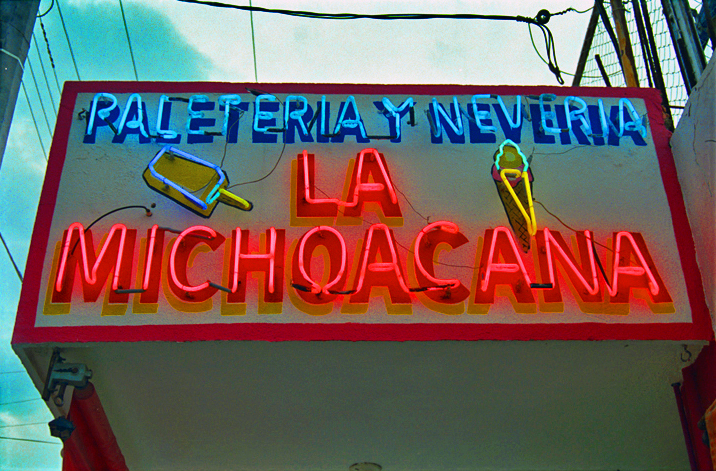
Paleteria.  Sabinas, Coahuila, Mexico, April 2002

I don't plan on leaving this earthly realm like Eggleston, leaving over 1,000 rolls of film in the freezer.  In fact, I am now below 90.  Just picked up this somewhat faded, but nonetheless sweet frozen treat from Walgreen's just today.  After nearly a decade in the Frigidaire, this one still makes my mouth water.

Thursday, July 8, 2010

Recovered Silver: Bringing Negatives Back From the Dead

Howard Johnson's Restaurant, U.S. Route 30,
Chambersburg, Pennsylvania, c. 1989


With some Photoshopping, these negatives can be largely restored.  I lost seventy-five per-cent of my negatives in a flood, and these are what the "survivors" look like.  These two frames were exposed at a Howard Johnson's restaurant in south-central Pennsylvania.  Like most of its orange-roofed brethren, it is now closed.

Wednesday, June 23, 2010

Los Colores de Coahuila

Piedras Negras, Coahuila, March 2000

As readers of this blog can surmise, I spent a lot of time in the city of Piedras Negras.  The genesis for a series on the brilliant colors found in the state of Coahuila was here.  The juxtaposition of forms, of ostensibly ashen masonry and dry-rotting wood miraculously brought back to life by mere coats of paint is at once the simplest thing in the world, and also the most fascinating.

Tuesday, June 22, 2010

Los Colores de Coahuila

Piedras Negras, Coahuila, March 1999

Any urban or even small town landscape in Coahuila would be incomplete without telephone and power lines to establish the image's geometry.  

Sunday, June 6, 2010

Here, kitty kitty!


Jane Eyre, San Antonio, Texas, July 1997

Pictured is our lovely cat Jane, who was born in late 1996.  We named her "Jane Eyre," as she was orphaned.  She suffered a horrendous mauling under the wheels of a garbage truck, but held on for life, and was nursed back to health by a dear friend who worked as a veterinary assistant.  She was adopted soon after her recovery.

She is still quite an active cat, going on fourteen and living a lazy life of eating, sleeping, and protecting her territory.

Monday, May 17, 2010

Los Colores de Coahuila

Piedras Negras, Coahuila, March 2001


On one of my first trips to the lovely city of Piedras Negras, I took a half dozen rolls of Walgreen's Studio 35 film in 200 ASA, which is in reality repackaged Agfa HDC-200.  As it was a nice, breezy March day, and people were out and about in the city center, I was able to get a lot of surreptitious shots such as this one, glimpses into people's everyday private lives in public.

If you really think about it, the most important information takes place in less than one-eighth of the image area, in a small sliver that nonetheless tells the whole story.

But, we're in Mexico here, where people adorn their places of business in bright, festive colors.  As a result, the crux of the image is wrapped in slashing diagonal lines of the barber's pole in red, white, and blue. The plate glass window's reflection gives context of the barber shop's city locale.

When I first printed this photograph, I was overwhelmed by the sheer amount of visual information which all converged towards its center -- whose simple composition of a barber's hand steadying a boy's head, as he gives him a haircut -- is yet undisturbed.

Sunday, April 25, 2010

Los Colores de Coahuila


Piedras Negras, Coahuila, March 1999

Every picture tells a story, but sometimes a picture has a backstory.  During my first visit across the border to Mexico, I stopped in the beautiful city of Piedras Negras, across the Rio Grande from Eagle Pass.

I'm used to people asking me what I'm doing, photographing insignificant ephemera.  In Texas, I usually get a long drawn-out "Yep.....Right.....Uh huh."  Trust me, Hank Hill is alive and well there.

Mexicans tend to be a bit more upfront.  For example, I was standing in the town plaza in Villa Union, about fifty miles inside the border, and this guy pulls up next to me and says, "Hey!  You're white!"  It was hilarious, because he was as gregarious as you'd ever want to meet; he just got to the point more directly (you don't see white tourists beyond the border towns in Coahuila much).

Back to this photo:  It was taken outside an auto repair garage and car wash.  As I was stooping to snap the picture with my Ricoh KR-5, one of the mechanics on duty asks me, "What are you taking a picture of?"

Instead of giving my usual sarcastic answer (I tend not to be droll when a guest in someone else's country), I replied, "I'm shooting the gravel.  That chain and broken bits of glass are really interesting."

His response made me laugh out loud, as he told his co-worker, in English, "See that?  He's taking a picture of the gravel."

"Huh?  The gravel?"

"Yeah, he's taking a picture of the fucking gravel, man!"

God, I miss Mexico!