Powered By Blogger
Showing posts with label california. Show all posts

Wednesday, February 18, 2015

Glorious Fujifilm Superia 200

Mission San Francisco de Asis (Mission Dolores)
San Francisco, California, October 2014


It is not news that digital has almost completely overtaken film in the past decade.  Film users have been marginalized since around 2003.

But that does not mean that film photography has remained at a standstill.  Fujifilm has continually been improving the quality of its products, even in their consumer lines.  I was on a shoot in the San Francisco Bay Area  this past fall, and ran out of Kodak Ektar 100 print film, so I bought a 4-pack of the only film the Safeway in Petaluma carried.

I popped it into my Hasselblad Xpan, and hoped for the best.  But little did I realize I would get the best.  The tonal range, color fidelity, and saturation easily match Fuji's NPS-160 professional film of just fifteen years ago.  A most pleasant surprise, and a big thanks to Fujifilm!

Thursday, August 14, 2014

Bodega Head State Park


Bodega Head is part of the Sonoma Coast State Park in California. Sonoma Coast is made up of several beaches that are separated by rock bluffs and headlands. It spans 17 miles from Bodega Head to Vista Trail which is 4 miles north of Jenner. Everyone from beachcombers, picknickers, sunbathers and fisherman can access the beaches from over a dozen trail points along Highway 1.

This photo show Bodega Head, which is a rocky headland that forms the entrance into Bodega Harbor. Crabbing is very popular here and there are many hiking trails on the ocean side that allow access to small coves and scenic views. Many people go to the high cliffs to observe migrating gray whales.

Stats: Hasselblad Xpan / Hasselblad-Fujifilm 45mm/f4
Fuji Superia 200 print film

Thursday, January 26, 2012

California Again

 Wool Growers' Restaurant
Los Banos, California, October 2009

I began my series on the farmers of California's San Joaquin Valley on this particular day, in October 2009.  I had begun photographing at the San Juan Reservoir early in the afternoon, and by the time I was finished, I asked the park guide where I could get a good meal.

He directed me to the famous Wool Growers' Restaurant in Los Banos, ten miles away.  Wool Growers' is a French Basque restaurant which serves its food - lamb stew, fried chicken, boiled cabbage and potatoes, and tons of bread and wine - family style.  I could barely finish half of my meal, though the farmers sitting nearby cleaned their plates.  Farming is some strenuous labor.

Sunday, August 28, 2011

Tomatoes!

 Tomatoes on conveyor belt to washer
Ingomar Packing Facility, Los Banos, California, July 2011


It slices, it dices, look at that tomato! You could cut a tin can with it, but you wouldn't want to!

Friday, August 26, 2011

Pixley Tire Shop Revisited

Pixley Tire Shop, off State Highway 99
Pixley, California, July 2011

I always like to revisit places I've photographed before, particularly during different times of day, and even seasons, when the light is different.  In this case, I was able to photograph the south face of the tire shop in Pixley, California, which I had previously visited in November of 2009.   Using my Nikon this time instead of a camera phone, and some rather flat Kodak Gold 400, I got an interesting look for this shot I took around 9:00 am.

Wednesday, August 24, 2011

Tomato Harvest In the San Joaquin Valley

Tomatoes and Vista of California's Coastal Mountains
Huron, California, July 2011

Dear readers, my apologies for being "gone" most of the summer.  If this were any normal blog, I'd be updating it via my Blackberry, Droid, or iPhone.  But, being the low-tech Luddite I am, I still do things the old-fashioned way -- on film.

I spent two weeks in the San Joaquin Valley of central California this summer, capturing the majestic vistas found there, farmers and farm laborers doing the backbreaking -- yet highly efficient -- work of putting food on America's and the world's dinner tables.  The panoramic vistas I snapped on the Hasselblad X-Pan, and the grit, grime, and guts of the people bringing the harvest to market I shot on my trusty Nikon FM-3A.  Instead of cards and memory sticks, I captured these images on Agfa's brilliant Optima II 100 film (see above) and Kodak Tri-X black and white 400 ASA.

It was worth the wait.

Monday, July 18, 2011

Mission San Juan Bautista, California

U.S. Route 101, South of San Juan Bautista, California, July 2011

California's Mission San Juan Bautista was founded by Spanish fathers as the fifteenth of twenty-one Roman Catholic missions in 1797.  Named for St. John the Baptist, the mission represents redemption through the cleansing of sin, and acceptance of Jesus Christ as one's savior.

  Mission San Juan Bautista, San Juan Bautista, California, July 2011

But for the avid moviegoer, the mission is immortalized as the place where a torn Kim Novak and an obsessive James Stewart brought themselves to a point well beyond redemption in Alfred Hitchcock's masterpiece, Vertigo, filmed here in 1957, and released the next year.

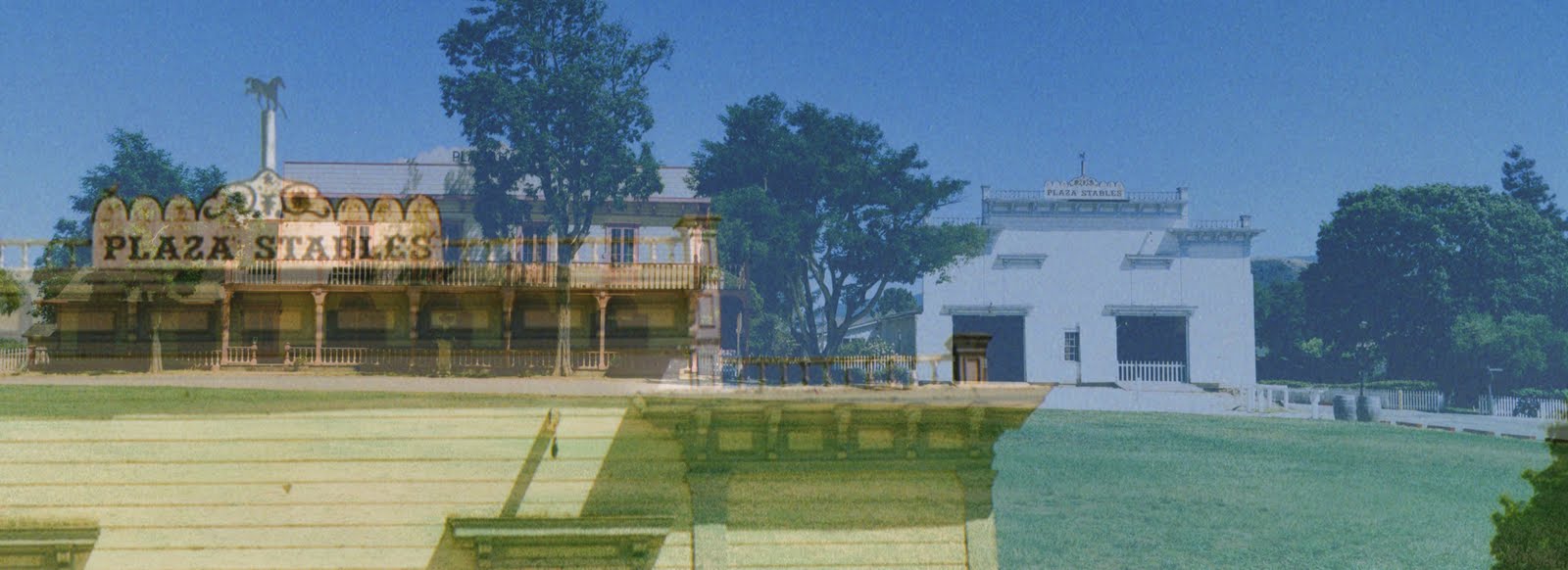
The mission has changed little since Hitchcock and Robert Burks, director of photography, filmed Vertigo more than 50 years ago, with one exception: The tower where the movie's climatic scene takes place was a figment of set designer Henry Bumstead's imagination, and inserted into the film by way of matte painting.

San Juan Bautista's fictitious tower, Henry Bumstead, designer, 1958
Image copyright 1958, Universal Studios


  The mission church as it exists in reality, with a smaller, external bell tower to right;
The missions original bell tower was destroyed in a fire in the 1800s
Photo taken July 2011

 I was able to capture these images with the amazing Hasselblad Xpan camera, which captures its images on a focal plane 65mm wide by 24 mm high, the exact same in-camera dimensions as Paramount's VistaVision camera, on which Vertigo was shot in Technicolor.  The second of these  photographs was taken on Kodak's Vericolor III film, which has not been available since the 1990s.  But the rest were photographed on CVS drugstore 200 ASA color film, which is really rebranded Fuji Superia.  It is amazing how the drugstore film of today has truer colors and better accutance than the pro film of yesteryear.


 Detail of Plaza Livery Stable, July 2011

Standing outside the mission, I can hear Bernard Herrmann's mesmerizing soundtrack in my mind.

Dissolve of Livery Stable and Courtyard, July 2011

Courtyard, Plaza Hall, and Livery Stable, as seen from Convent arch, July 2011

Plaza Hotel, July 2011

Mission San Juan Bautista and courtyard, July 2011 
 

In addition to the mission at San Juan Bautista is the lovely small town of the same name, where you can dine in very civilized fashion at Joan and Peter's German Restaurant, which makes one of the best Sauerbratens I've had in the United States, and a Westfalischen Schnitzel the California way, with melted Monterrey Jack cheese.

Thursday, June 23, 2011

Going To California

Fallow land, outside Mendota, California, aerial shot, June 2010

Next week, I'll be continuing work on my pictorial essay on the San Joaquin Valley in California.

Click on this image.  What you see is not land that has gone fallow because of the prudent agricultural practice of crop rotation, but land that has been fallow for years -- and perhaps, for evermore -- because of misguided, so-called "environmentalists" in the Federal government who are sacrificing the nation's most fertile farmland to the ravages of soil erosion, in the name of allegedly saving a tiny fish called the "Delta Smelt."  

Never mind that the Delta Smelt is in more danger from urban users upstream near Sacramento, who overwhelm Northern California's waterways with millions of gallons of untreated sewage every single day, what is more important is that the Beautiful People -- the upscale yuppies who need only "care" for the environment -- have more numbers than "Those People," the farmers and Mexican laborers downstream who are among this nation's best stewards of farming land (in all my travels through the Central Valley, I've maybe seen ten or twelve tanks of anhydrous ammonia in total, versus a dozen -- to scores -- in every farming town in Minnesota, where I currently reside).  

Who cares that there is 40% unemployment in the heart of America's farming paradise?  Not the important people.  Important people think that food grows in the produce section of their local Whole Foods or Safeway.  The "important" people upstream could care less whether food comes from their own home state, or China, or South America.  They don't have to live with the people who are watching the American Dream going down the sewer: People who came to this country out of the hope of making better lives for themselves and their children, and now are watching that hope slip away from them as their numbers become casualties to the scourge or drugs, alcohol, dropping out of school, and crime.

The Left turns their backs on the people who do the real work in this country, because they're just a bunch of gauche hicks after all, clinging to their guns and religion, while the Right turns their backs on their fellow American farmers because they hired workers of somewhat darker complexion who committed the unpardonable sin of wanting to bust their humps for a pittance of a wage.


Friday, September 17, 2010

A.K.A. Pablo

Actor and comedian Paul Rodriguez
Latino Water Coalition, State Capitol
Sacramento, California, October 2009

Paul Rodriguez is a stand-up guy in more ways than one:  His support of family farmers in the San Joaquin Valley by bringing the issue of the drought forced upon them by the Federal Government is commendable, and spurred the California legislature and Gov. Schwarzenegger to enact measures to deliver badly-needed water to the farms of the Central Valley.

Monday, July 12, 2010

Harvest of Sorrows

Interstate Highway 5, near Firebaugh, California, October 2009


No crops were planted on this land last year.  None will be planted this year, and next year is probably a wash as well.

Under the Endangered Species Act, and in the name of "saving the planet," half of the farm land in California's San Joaquin Valley is going fallow, and what was once the nation's most fertile ground is falling victim to soil erosion.  Farmers are being denied the use of water on their own land, in order to "save" the Delta Smelt.  Yet, as this video argues, the danger to the species of fish comes not from California's farmers, but from cities and industries upstream, who are using the environmental movement as a cat's paw to cover their own pollution.

Tuesday, June 29, 2010

Hungry Like the Wolf


State Highway 41, Lemoore, California, October 2009

Doesn't this sign make you hungry?  It did me, but to no avail:  This diner has been closed down and boarded up for years, in this depressed farming community in the Central Valley of California.

Monday, June 28, 2010

Fruits of Labor

State Highway 152, near Los Banos, California, October 2009


If you've been wondering where I went for the past week, I've been out in the San Joaquin Valley of California working on my next project, for which I will divulge details soon.

Now that I am devoting myself full-time to this project, I am pleased to present this as the first image from this upcoming series, a photograph I took of the side of a fruit stand October last.


Thursday, March 25, 2010

Requiescat In Pace

Johnny Cash at San Quentin Prison.
Photograph by Jim Marshall, 1969

Another great photographer has been called home,  Jim Marshall (1936-2010).  His fame peaked in the late 1960s to early 1970s, as a photographer of the music scene whose portraits of such rock legends as Jimmy Page and the Beatles were as iconic as photographs of Annie Leibowitz or Linda McCartney.

Read his obituary here.

Hope they got Tri-X up there, dude, because you can't hardly find it down here.

Wednesday, March 24, 2010

Camera Phone Heresies

Pixley Tire Shop, Pixley, California, November 2009

I pulled off California State Highway 99 to photograph this tire shop.  Tire shops and corrugated metal have always held a special fascination for me.

At that particular time, I was using my Nikon FM-3A (the last generation of the famous Nikon F/FM series professional manual camera bodies), which was loaded with Kodak Tri-X.  Having exposed the last frame, I was about to return to my car when this little boy happened by.  

Thinking on my feet, with no time to reload, I took my Motorola cell phone from my pocket and snapped this picture up.

Now, anyone who knows me will tell you my deep-seated loathing for digital photography.  To me, it's cheating -- damned if I'm going to just flush thirty-plus years of acquired knowledge of real photography down the drain just because somebody invented a way to mimic photography.

But, as Ralph Waldo Emerson said, "A foolish consistency is the hobgoblin of little minds."  Which means, don't let a great photo opportunity pass you by just because you're a retrograde purist (such as I) standing on ceremony.