Powered By Blogger
Showing posts with label nikon fm-3a. Show all posts

Wednesday, November 5, 2014

The Colors of Fall on Film


Who doesn't enjoy the colors of fall in the Midwest? I know I do. Color film does too and this Agfa Ultra 50 print film replicates it with an unparalleled beauty. The range of colors and saturation that you get out of it is a treat for the eye. This photo was taken in West-Central Michigan using my Nikon Fm-3A with a Nikkor 50mm 1.4.

Wednesday, October 29, 2014

Desert Oasis?


What's the first thing that comes to mind when you see this photo? The Sahara? Camels? Well, while you may be able to ride some camels through here, these dunes are actually right here in the United States. Oh, so we're talking Nevada, or Utah? No, and no. These sand dunes are in Michigan.


Silver Lake State Park is comprised of both mature forest land and over 2,000 acres of sand dunes. The park is divided into three segments: An all terrain park in the northern area, the Walking Dunes in the middle of the park, and the southernmost section that is leased to Mac Wood's Dune Rides.

Stats: Nikon FM-3A / Nikkor 50mm/f1.4 / circular polarizerAgfa CT Precisa Plus 100 reversal film

Wednesday, September 17, 2014

Dr. Strangelove


The "Dr. Strangelove Room" at Diefenbunker, Canada's cold War Museum, Carp Ontario, July 2014

Nikon FM-3A / Nikkor 24mm/f2
Fuji Sensia 200 reversal film, pushed +1

Thursday, July 24, 2014

Howard Johnson: The Decline of an Era


In the 1960s and 1970s, there were more than 1,000 combined company owned and franchised Howard Johnson outlets. It was the largest restaurant chain in the U.S. at the time.

Howard Johnson started out owning and operating a small corner pharmacy in Quincy, MA. Little did he know that the food industry would become his legacy. After he installed a soda fountain in his drugstore, he realized that the fountain was quickly becoming the busiest and most profitable part of his store. With the mind of an entrepreneur, Johnson decided to branch out into homemade ice cream, quickly accumulating a large variety of 28 different flavors.

During the summers of the late 1920s, Johnson would opperate concession stands along beachfront property on the coast of Massachusetts. He sold soft drinks, hot dogs, and ice cream. With the growing success of his pop-up concession stands, he was able to convince bankers from the area to lend him enough money to open and operate a sit-down restaurant. Finally, near the end of the decade, the first Howard Johnson's restaurant was opened in Quincy. The menu included fried clams, baked beans, chicken pot pies, hot dogs, ice cream, and soft drinks.

Johnson received a rather lucky break in 1929 when the mayor of Boston prohibited a production of Eugene O'Neill's play, Strange Interlude, from performing. The theater moved the production to Quincy, and the influential Bostonians that came to see the play flocked to the closest restaurant, which happened to be Howard Johnson's.

In the 1930s, Johnson persuaded an acquaintance to open a second restaurant in Orleans, Massachusetts which ended up being on of America's first franchising agreements. By the end of the 1930s, there were 107 restaurants all along American East Coast Highways.

By 1944 though, ravaged by the effects of war rationing, only 12 restaurants remained in business.  Johnson managed to maintain his business by serving commissary food to war workers and United States Army recruits. By 1951 though, the restaurants sales were back up and totaled $115 million.

The first motor lodge for Howard Johnson was opened in 1954 in Savannah, Georgia. Shortly after that, in 1959, the elder Johnson turned the company over to his 26 year old son. He would continue to oversee his son's control of the company until his death in 1972.

When the company went public in 1961 there were 605 restaurants and 88 franchised motor lodges across 32 states. By 1975, the company had more than 1,000 restaurants and more than 500 motor lodges in 42 states and Canada. This would be the peak of the business. By the late 1970s though, the signs of the end were beginning. Between the oil embargo of 1974, the fire of 1971, the day-long siege that former Black Panther Mark Essex used the hotel's roof for as a sniper perch, and the $2.5 million dollar judgement awarded to Connie Francis who sued the motel chain after she was raped at the Howard Johnson's Jericho Turnpike lodge, the company started failing. Along with that, Johnson tried to streamline the company operation and cut costs which proved disastrous because guests were unhappy with the "new" Howard Johnson's after being accustomed to the services that they had known for the previous years.

In 1979, Johnson accepted a bid from Imperial Group PLC who sold the company to G. Michael Hostage for more than $630 million.

This Lake Placid restaurant was one of the only three remaining restaurants. It closed on March 31, 2015.

Stats: Nikon FM-3A / Nikkor 24mm/f2
Agfa RSX II 100 reversal film
Taken July 2014


Tuesday, January 7, 2014

Oh, Canada


Near Beardmore, Ontario, Canada, June 2012

Nikon FM-3A Nikkor 50mm/f1.4
Agfa RSX-II 100 film


Construction of Canada's Trans-continental highway began in 1950 and it is one of the world's longest national highways, stretching an amazing 8,030  KM (or 4,990 MI). It was officially open for business in 1962 and completed in 1971. 

The highway is recognized distinctively by the white-on-green maple leaf route markers, such as the one pictured above. 

As you travel across this highway, prepare to be awe-inspired by the scenery. A traveler will experience everything from the majestic peaks in Banff National Park to the prairie areas of Saskatchewan.

Tuesday, September 18, 2012

eBook "Looking Down" Released


I am pleased to announce the release of my second book, Looking Down: Photographs From the Sidewalks of Hyde Park, Boston, published by Middlebrow Books.
Looking Down is an intricate look at the ephemera found on the pavements of one of Boston's more quiet, outlying neighborhoods.  

This handsome edition includes a duotone monograph with 75 original prints. With a very personal essay by motion picture historian Dan Auiler, and cover design by Deidre Adams, Looking Down is a beautifully understated book that will lend charm, grace, and dry wit to your eBook reading device.

Looking Down is on sale at amazon.com, and Barnes & Noble.

Thursday, January 26, 2012

California Again

 Wool Growers' Restaurant
Los Banos, California, October 2009

I began my series on the farmers of California's San Joaquin Valley on this particular day, in October 2009.  I had begun photographing at the San Juan Reservoir early in the afternoon, and by the time I was finished, I asked the park guide where I could get a good meal.

He directed me to the famous Wool Growers' Restaurant in Los Banos, ten miles away.  Wool Growers' is a French Basque restaurant which serves its food - lamb stew, fried chicken, boiled cabbage and potatoes, and tons of bread and wine - family style.  I could barely finish half of my meal, though the farmers sitting nearby cleaned their plates.  Farming is some strenuous labor.

Tuesday, June 21, 2011

Sunday, November 28, 2010

Semi-Abandoned Bikes

Bicycles. Coney Island, Brooklyn, New York, April 2003

It is entirely possible that these bicycles are still chained to this signpost, more than seven years after the fact.  There is an off chance their owners returned to reclaim them. It is more probable the New York City Department of Highways sent someone over with a bolt cutter, and released these simple transportation machines back into the wild.

Of all my years in New York, I can never understand why people wrap their bikes in Hulk-proof chains and hasp them with Brinks-grade locks, only to abandon them to time and the elements.

Friday, September 17, 2010

A.K.A. Pablo

Actor and comedian Paul Rodriguez
Latino Water Coalition, State Capitol
Sacramento, California, October 2009

Paul Rodriguez is a stand-up guy in more ways than one:  His support of family farmers in the San Joaquin Valley by bringing the issue of the drought forced upon them by the Federal Government is commendable, and spurred the California legislature and Gov. Schwarzenegger to enact measures to deliver badly-needed water to the farms of the Central Valley.

Thursday, August 26, 2010

Food Fetish

Cafeteria automat conveyor, Passau, Germany, July 2010

I'll admit it: I'm a culinary voyeur.  

This photo is for Ana, whom I was aesthetically channeling as I snapped up this image.

Tuesday, August 24, 2010

Auteur

Photo guru Klaus Ditté, Passau, Germany, July 2010


If Akira Kurosawa were alive and not dead; were German and not Japanese; and were a photographer and not a director....

....he'd be this man.

Thursday, August 19, 2010

La Boqueria, Part IX

Puppet. La Boqueria, Barcelona, Spain, July 2010


At night, this seemingly benign creature awakes and prowls the floors of La Boqueria, marshaling an army of insects and vermin which will soon take over the world!

Thursday, August 12, 2010

La Boqueria, Part VIII: Jamon Iberico

Jamon Iberico. La Boqueria, Barcelona, Spain, July 2010

I am not a fan of Tapas bars, with their minimalist portions.  The custom of grazing on small portions throughout the day is tedious and absurd -- after your third Tapas "meal," you begin to get that Bill Murray/Groundhog Day deja vu feeling.  I prefer the Italian tradition of a big lunch of pasta and a midday rest until three.

That said, as I was forced to eat at these Tapas places during meetings with friends in Spain, I did reacquaint myself with a delicacy known as jamon Iberico. Quite literally, Spanish ham.  It's shaved razor-thin and often served on bread, or alone on a plate, and is the most heavenly pork confection my taste buds have ever experienced.  Think of it as Canadian bacon crossed with prosciutto.  I'm in pig heaven!

Tuesday, August 10, 2010

La Boqueria, Part VII: Peppers

Peppers. La Boqueria, Barcelona, Spain, July 2010

Looks like a San Antonio doorway around Christmastime!

La Boqueria, Part VI: Smooth Up In Ya

Fruit smoothies. La Boqueria, Barcelona, Spain, July 2010

This lovely lady implores you, "Have a smoothie!"

:)

Monday, August 9, 2010

Frutos del Mar: La Boqueria V

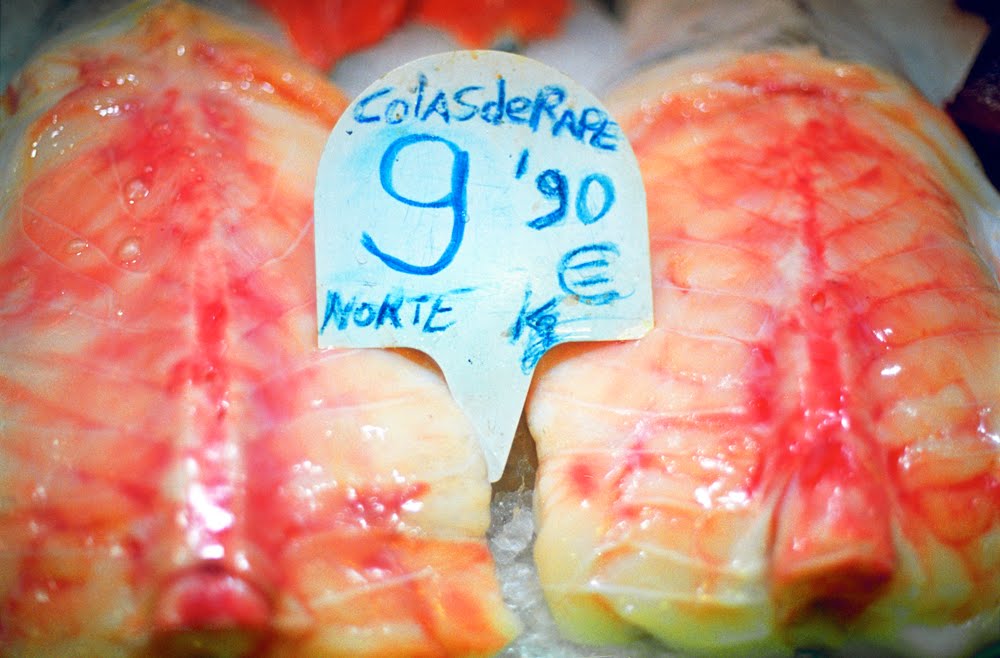
Whitings at fish market. La Boqueria, Barcelona, Spain, July 2010


Monkfish tails. La Boqueria, Barcelona, Spain, July 2010

I have never been a seafood eater.  With the exception of tuna salad, I don't eat fish.  Forget about shellfish -- I've no use for bottom-feeders.

Yet, some of my fondest memories as a boy were going to Lexington Market, Baltimore's renowned open food market.  There is no market in the world that can rival Lexington Market for a tour of smells:  From the dogs and sausages grilling at Pollock Johnny's, to the roasted Brazilian nuts, the cotton candy, and my favorite smell -- the most distinctly Baltimorean of them all -- crabcakes frying.

And when it came to sights, I would marvel at the fish.  The lobster tank, the crab salads, the trout, and German pickled herring from Chesapeake Bay..... You gotta go there sometime and see it for yourself.

My time at La Boqueria brought me back to all that, in its own way.

Sunday, August 8, 2010

La Boqueria, Part IV

Watermelons, peppers. La Boqueria, Barcelona, Spain, July 2010

It's hard to believe, but these ultra-fresh looking watermelons are now either human byproducts floating in Barcelona's sewers, or they went unconsumed, and are rotting in some compost pile.  But, thanks to this Agfa film I've preserved in my freezer for seven years, their fuscia, lime, and salmon hues will be fresh for eternity.  

Saturday, August 7, 2010

La Boqueria, Part III

Egg vendor, La Boqueria, Barcelona, Spain, July 2010


The series of photographs I took at La Boqueria were also very technically interesting to me:  I exposed my first rolls of Kodak Ektar 100 there, but I also shot a number of rolls of Agfa's highly-saturated Ultra 100, a now-defunct stalwart of mine which has been in the freezer for seven years.  Although I had to do a little more tweaking in Photoshop, I got very similar results with the color-curves and saturation, although the Agfa was significantly grainier.  

I am so glad Kodak did the right thing for once, and brought back a film they killed in the mid-1990s.  Still, I purchased many bricks of the Ektar in 35mm and 120, because I'm not counting on Kodak to continue doing what's right.

Friday, August 6, 2010

Colorful Czech Republic

Advertisement detail. Federal Highway 39, Horní Planá, Czech Republic, July 2010

After the fall of the Berlin Wall, the formerly greywashed Czechoslovakians went wild with all manner of colorful paints to enliven their surroundings.  If I hadn't known otherwise, I would have thought I was in Mexico during this delightful sojourn into territory once verboten to NATO soldiers.

Tire tower, Federal Highway 39, Cerná v Posumaví, Czech Republic, July 2010


Political advertisement, Federal Highway 39, Želnava, Czech Republic, July 2010