Powered By Blogger
Showing posts with label kodak ektar 100. Show all posts

Wednesday, March 12, 2014

Black Gold


U.S. Route 50, Capon Bridge, West Virginia, June 2013

Rolleiflex SL-66, Zeiss Planar 80mm/f2.8

Kodak Ektar 100 film

Oil. It's been a part of our history for generations. Rockefeller provided the nation with fuel for lamps and streetlights and then figured out how to use the "trash" as fuel for the horseless carriage. We have fought wars over it, rejoiced in the finding of it, cringed over the prices of it, all in the name of convenience and demand. 

Gulf Oil, or the company that we know as Gulf oil, was started in 1901 after the discovery of oil at Spindletop, near Beaumont, Texas. A group of investors, the largest being William Larimer Mellon of Pittsburgh Mellon banking family, joined forces to promote the development of a modern refinery in the nearby Port Arthur to help process the oil. 

Spindletop's output peaked early on at 100,000 barrels per day. The early peak and decline forced Gulf to find alternative sources of supply to sustain its substantial investment. The effort to do so resulted in the construction of a 400-mile pipeline connecting oilfields in Oklahoma with Gulf's refinery at Port Arthur. This pipeline was known as the Glenn Pool pipeline. 

The distinctive Gulf logo was an assurance of sorts for the "name brand" oil so people purchasing it knew they were getting good quality gasoline. At this time in the United States, non-branded gasoline was often contaminated or of unreliable quality. 

This photo shows a sign, though old and worn and riddled with holes, that defined a company. Logos are an influential part of today's society and oftentimes a logo is literally the first and last impression people get from a company. A brown and gold shield, a white eagle on a blue background, a blue oval or a red target. All these signs are what influence us and stay as reminders in our mind. 

Gulf oil may not be in its hayday anymore, but the distinctive orange sign will always be associated with it. 


Thursday, November 17, 2011

Garish - Retooling

Dairy Queen, U.S. Route 63, Stewartville, Minnesota, November 2011

It has been quite a long while since a film emulsion has excited me.  It used to be a quarterly -- sometimes even monthly -- event.  But with the ascendancy of digital and the waning of film, it's become somewhat akin to listening to a favorite band's long-awaited release on vinyl.

The last time I got this excited was the summer of 2010, when I returned from Barcelona with a number of exposed rolls of Kodak Ektar 100, and found that not only was the color superior to Agfa's old Ultra 100 emulsion, but that its grain was even finer than Agfa Ultra 50.  It was as though Eastman Kodak had retooled Ektar 25, but made it jump two stops without any loss in resolution.

Well, with the demise of Polaroid, I am starting to run out of their wonderful 669 and 690 Polacolor pack films I use in the Polaroid Colorpack cameras. So, preparing for the inevitable, I purchased a few packs of Fuji's FP-100C Professional pack film, which replaces Polaroid 690.

Now, while I shoot Polacolor for its obviously "off" colors (who doesn't love their loam green and cyan skies of 669 film?), I found the color way truer than even the 690 film, which was a vast improvement in color accuracy over 669.  In fact, the above photo recalls Fuji's marvelous E-6  emulsions, and instantly reminded me of many transparencies I have made on their Astia and Sensia films.  (The above has not been tweaked for color balance, nor for saturation).

Even more astounding was the exposure latitude on this stuff!  Whereas Polacolor (in either 669 or 690) would have had lost detail and murky shadowing in the darker areas, the Fuji maintained detail in both the shaded and shadow areas.
This is an astounding find!  Although this film has been around for a while, I was a Polacolor diehard.  I still prefer to use it (I honestly don't shoot it for reasons of color and tonal fidelity - I use it because of -- not despite -- its flaws).

Still, I have a new snapshot stalwart awaiting me when I run out of the great old stuff, and I am looking forward to new ways of seeing the things I shoot.


Thursday, August 19, 2010

La Boqueria, Part IX

Puppet. La Boqueria, Barcelona, Spain, July 2010


At night, this seemingly benign creature awakes and prowls the floors of La Boqueria, marshaling an army of insects and vermin which will soon take over the world!

Friday, August 6, 2010

Colorful Czech Republic

Advertisement detail. Federal Highway 39, Horní Planá, Czech Republic, July 2010

After the fall of the Berlin Wall, the formerly greywashed Czechoslovakians went wild with all manner of colorful paints to enliven their surroundings.  If I hadn't known otherwise, I would have thought I was in Mexico during this delightful sojourn into territory once verboten to NATO soldiers.

Tire tower, Federal Highway 39, Cerná v Posumaví, Czech Republic, July 2010


Political advertisement, Federal Highway 39, Želnava, Czech Republic, July 2010

Wednesday, July 28, 2010

La Boqueria, Part II

Bustle of the fruit market
La Boqueria, Barcelona, Spain, July 2010

I returned twice to La Boqueria, and exposed about five rolls of the highly-saturated C-41 color films Agfa Ultra 100 and Kodak Ektar 100 to capture the brilliance of the intense hues of the market.  Shooting with my Nikkor f/1.4 lens achieved the exact opposite of deep focus:  With its shallow depth of field, I could concentrate on composing with colors, rather than any particular objects.

The results were almost impressionist compositions that breathed with the fire of surrealistic color.  These prints are out of a Technicolor dream.  Fitting for their subjects' location.


Detail of grapes, La Boqueria, Barcelona, Spain, July 2010


American tourists at watermelon stand
La Boqueria, Barcelona, Spain, July 2010


Greengrocer and customer
La Boqueria, Barcelona, Spain, July 2010


Butcher and customer
La Boqueria, Barcelona, Spain, July 2010

Tuesday, July 27, 2010

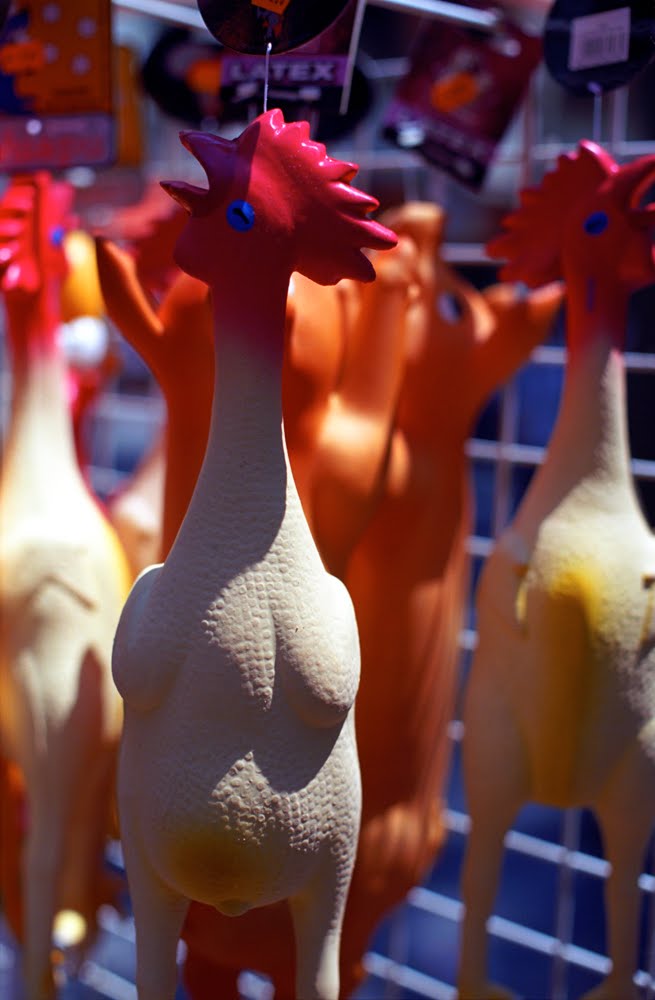
Rubber Chicken Dinner

Rubber Chickens
Busker's Stall, Ramblas, Barcelona, Spain, July 2010

One of the biggest tourist draws on the Ramblas -- Barcelona's pedestrian walkway which intersects the Catalan city -- is La Boqueria, the great fruit market.

The stall owners here all have artistic flair, a vivacious sense of color (heightened by the use of sodium vapor lamps) and a knack for arranging their wares in patterns which appeal to the graphically sensible.

Altogether, a visual feast for the eyes and heaven for the nose and mouth.


Produce, La Boqueria, Barcelona, Spain, July 2010


Fruit salad arrangement, La Boqueria, Barcelona, Spain, July 2010