Powered By Blogger

Thursday, June 23, 2011

Going To California

Fallow land, outside Mendota, California, aerial shot, June 2010

Next week, I'll be continuing work on my pictorial essay on the San Joaquin Valley in California.

Click on this image.  What you see is not land that has gone fallow because of the prudent agricultural practice of crop rotation, but land that has been fallow for years -- and perhaps, for evermore -- because of misguided, so-called "environmentalists" in the Federal government who are sacrificing the nation's most fertile farmland to the ravages of soil erosion, in the name of allegedly saving a tiny fish called the "Delta Smelt."  

Never mind that the Delta Smelt is in more danger from urban users upstream near Sacramento, who overwhelm Northern California's waterways with millions of gallons of untreated sewage every single day, what is more important is that the Beautiful People -- the upscale yuppies who need only "care" for the environment -- have more numbers than "Those People," the farmers and Mexican laborers downstream who are among this nation's best stewards of farming land (in all my travels through the Central Valley, I've maybe seen ten or twelve tanks of anhydrous ammonia in total, versus a dozen -- to scores -- in every farming town in Minnesota, where I currently reside).  

Who cares that there is 40% unemployment in the heart of America's farming paradise?  Not the important people.  Important people think that food grows in the produce section of their local Whole Foods or Safeway.  The "important" people upstream could care less whether food comes from their own home state, or China, or South America.  They don't have to live with the people who are watching the American Dream going down the sewer: People who came to this country out of the hope of making better lives for themselves and their children, and now are watching that hope slip away from them as their numbers become casualties to the scourge or drugs, alcohol, dropping out of school, and crime.

The Left turns their backs on the people who do the real work in this country, because they're just a bunch of gauche hicks after all, clinging to their guns and religion, while the Right turns their backs on their fellow American farmers because they hired workers of somewhat darker complexion who committed the unpardonable sin of wanting to bust their humps for a pittance of a wage.


Tuesday, June 21, 2011

Monday, June 20, 2011

Out of the Box: Rediscovered Photographs

Barber Shop, Hyde Park
Boston, Massachusetts, September 2000


So, I ask the two barbers if I can snap a photograph of them in their shop.  No problem. 

The client has a problem.  "Well, you can cover your face if you don't want anyone to recognize you," I offer.

Problem solved!

Friday, June 17, 2011

One Lonely Night

U.S. Route 522, Fulton County, Pennsylvania, October 1989

I found this photograph, eerily reminiscent of Hitchcock's Psycho on many levels, in a box while unpacking. (As prior military, I still haven't unpacked everything yet; there are about thirty boxes yet to open).  Ah, to be 24 again, armed with a Ricoh KR-5 and Agfapan 100.

Saturday, June 11, 2011

Concrete Cathedrals

Grain Elevator
U.S. Route 150, Fithian, Illinois, June 2011

I saw this beautiful example of an early-20th century granary in rural Illinois, when I felt the pang of regret that I hadn't brought my Rolleiflex SL-66 medium format camera, my traditional tool for capturing these specimens of what photographer Chris Faust calls "commercial archaeology."

But then I remembered:  I had a medium format camera with me, a Polaroid Super Colorpack 108-format instant camera, loaded with color 669 film.  Thanks to Photoshop, I was able to tweak this into something silver halide.

Friday, June 10, 2011

Garish: The Next Generation

Unger Store, State Highway 13, Unger, West Virginia, May 2011

Some times, as a photographer, I luck out:  Unger's General Store closed down about four years ago, and I missed the opportunity to photograph this old country store, which had played such a crucial part of my teenaged years: I would often ride my old Team Raleigh ten-speed from my house outside of Berkeley Springs, West Virginia, to rural Frederick County, Virginia.  Sitting atop the ridgeline after a steep climb of many miles, Unger's store was just about the point when my bike bottle went dry.  Though there was no air conditioning in the store, just dunking my hand into the pop cooler to grab a glass bottle of Coca-Cola immediately reinvigorated me.  They made Coke with real sugar back then.  Today, you have to find a place that carries Mexican Coca-Cola to experience Coke as it ought to taste.  


My bicycle journeys took place some thirty years ago, but driving up Route 13 and finding the place still intact made it seem like yesterday.

Wednesday, June 8, 2011

Garish: The Next Generation

Mid-1970s Sebring Vanguard Citi Car SV-48
U.S. Route 136, near Brownsburg, Indiana, June 2011

Who killed the electric car?  Just stabbing in the dark here, but my guess is it was the guy who designed this "unsafe at any speed" micro econobox.  This loser was dead on arrival.  

I don't know what the industrial designer's previous resume items were, but I'm thinking set designer or propmaster for Woody Allen's 1973 futuristic comedy, Sleeper.

Friday, June 3, 2011

Garish: The Next Generation

Waffle House Restaurant, Arlington Road, Brookville, Ohio
June 2011

This is not a "Poladroid."  This is not something I tweaked in Photoshop or Lightroom, to make it look like a Polaroid print.  No, this is a Polaroid print, taken on 669 film with my Super Colorpack camera (which I bought on eBay for $3.50; may the Colorpack III rest in peace) just this week.

And, this beautifully stylized Waffle House restaurant -- which appears right out of the 1950s, with its lush landscaping -- looks simply stunning on real Polaroid film, a nice stash of which I keep stored in my Frigidaire.  You see, while Polaroid film will most often render washed-out looking skies (as it does in this print), it was engineered to also produce heavily-saturated colors (also evident here), something the techno-geeks at Poladroid didn't exactly factor into their bit crunching.  Like Marvin Gaye and Tammi Terrell sang, when music was also made in the analog format by artists who could read music and play instruments, "Ain't nothing like the real thing."

Baby.

Summer is here!

Monday, May 16, 2011

Ronnie James Dio: One Year Later


Ronnie James Dio passed into the afterlife one year ago, today.  This self-portrait is dedicated to his memory, replete with flashing horns to ward off the devils and daemons that may await him on his ascension from Purgatory, whilst he is breaking into Heaven.

Friday, April 29, 2011

New Book Launch: Los Colores de Coahuila

Guitarist, Piedras Negras, Coahuila, Mexico, March 2001

As Garish: Roadside Polaroids goes through its final tweaks and polishing, as it goes to press in the Fall, I am pleased to announce work has begun on my next volume, Los Colores de Coahuila, my excursion through the cities and villages of the Mexican frontier state of Coahuila, along the Texas border.

Juan Torrescano, in his essay for the book, comments, 
Robert Jones declares he does not want to use his images as a "deep" philosophical vehicle, nor does he want to concentrate on historical subject matters, but his images speak precisely to these topics (but without the verbiage to get in the way of his imagery): The aged troubadour, who dexterously strums his lira to please his improvised clients, the popsicle vendor who tirelessly runs through the broken pavements and alleyways with the desire to exhaust his goods, the proud rancher who places his hopes in the next season's harvest -- not to mention the spotted furious cock ready to enter into battle. The colorful juggling street clown in full attire, the snapshot of the smiling family, and what about the fortezza vecchia of the National Emblem, the effigy of the Patron Virgin of Mexicans? The flower vendors who avidly conquer their lady with a beautiful bouquet, as well as the figures of San Martin De Porres, the elderly woman, the barber, and the emerging mysterious gardener, the fresh fruit vendor, the roses in the church atrium, as well as the tower, and the stained glass windows. Or the scenes of  dogs and felines lounging in the sun, and the wide range of multicolored, stripped and weathered facades, doors, and windows. All this -- for the people of the border -- is a standing ovation. It gives integrity to a bland environment of brick walls  without decoration, or older houses that speak only of their abandonment. 
The tentative launch date for Los Colores de Coahuila is Spring 2012.


Thursday, April 21, 2011

Camera Phone Heresies: Crazy Horse Memorial


Crazy Horse Mountain Memorial, scultpted from an original model by Korczak Ziolkowski
Crazy Horse, South Dakota, April 2011

Of course, no camera phone could ever do justice to Korczak's immense mountain, which has since 1948 been transformed into a man and his horse.  But then, no camera could do full justice to this larger-than-life labor of love. This amazing rendition of the Lakota warrior Crazy Horse is a work in progress, still approximately five decades away from completion.

Located just miles from the famed Mount Rushmore, which Korczak was apprentice to Gutzon Borglum on in the late 1930s, Crazy Horse Mountain dwarfs the Presidential busts.  Indeed, all flour faces could fit inside of Crazy Horse's head. To understand the height and breadth of Crazy Horse Mountain, consider that it is taller than the Washington Monument and broader than the Great Pyramids and Giza.

What most impresses me about Korczak Ziolkowski was that ever since Lakota Chief Henry Standing Bear invited him in 1939 to carve Crazy Horse's likeness, not one penny of government money has gone to support its construction.  On principle, Ziolkowski refused a $10 million offer from the Federal Government to "help" him sculpt his mountain.  The Boston native was a rugged New England individualist, in the mold of Emerson, and didn't believe in sticking his hand out.  He knew that there's nothing "free" about government money, and that it always comes with strings attached.  He probably also knew that in the case of his sacred mission, it would be blood money he was accepting.

Sunday, April 3, 2011

Camera Phone Heresies: Wisconsin Trailer Park

U.S. Route 12, near New Lisbon, Wisconsin, April 2011

The simple eloquence of these hand-painted signs is disappearing in a rapidly standardized world. Before long, we'll all be forced to use kilometers, and to purchase the signs from government-approved manufacturers.    

Monday, March 14, 2011

Back From the Dead

State Route 9, Paw Paw, West Virginia
July 2004

In the hazy, lazy days of summer, this sign beckons the motorist to its cooling charms.  But here in Minnesota, ice is the nectar of the damned.  Whoever said "When Hell freezes over" has never had to spend his winter in Minnesota.  If he did, he'd use the present - not the future - tense.

Yet, the Earth here is thawing, the days are longer, and spring is around the corner.  I shall take up my camera, wind in a spool of film, and shake of this pneumonia-induced funk I've been in for months on end.


Saturday, December 18, 2010

Los Colores de Coahuila - Film from the Freezer

Street scene.  Location unknown, Coahuila, November 2004.

Of course, one of the problems of keeping film in the freezer forever is I sometimes forget where I took a certain photograph or roll of film.  This is one such case.  Nonetheless, it is a very intriguing scene.  

Tuesday, December 14, 2010

Icelandic Sojourn

Granaries, outside Reykjavik, Iceland, August 2001

So I visit Iceland, and what do I photograph?  The spectacle of Icelandic nature in panoramic Technicolor?

No:  I shoot stark black-and-white images of the industrial stuff.  Just performing a public service no one else will!  :)

Sunday, December 12, 2010

Stuff I Should Have Printed

Gnarled mesquite and epiphytes.  Kerr County, Texas, October 2000

When you go through hundreds of rolls of film in a year, it is entirely possible to miss great images like this one if you fail to contact print them.  Glad I finally got around to it.  

Friday, December 10, 2010

Los Colores de Coahuila - Film from the Freezer


Street Scene, Piedras Negras, Coahuila, Mexico, March 2001

One of the best unintended consequences of storing film in the freezer for nearly a decade is when a print such as this sneaks up on you, and quietly grabs you.  I usually don't go for understatement, but this forgotten scene was apparently just too elegant to pass up.

Thursday, December 9, 2010

Los Colores de Coahuila - Film from the Freezer

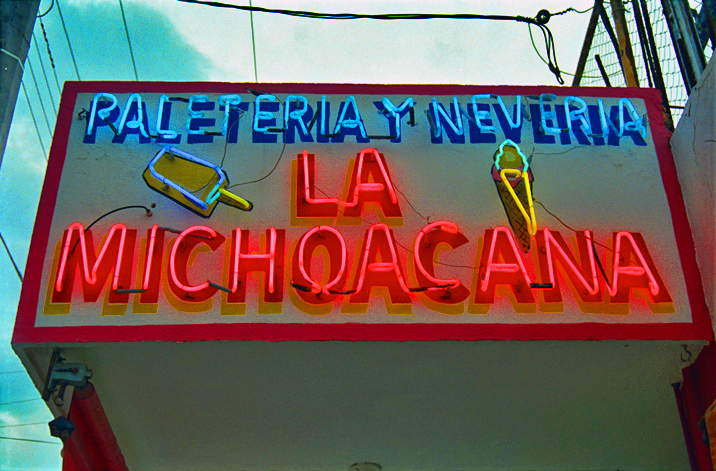
Paleteria.  Sabinas, Coahuila, Mexico, April 2002

I don't plan on leaving this earthly realm like Eggleston, leaving over 1,000 rolls of film in the freezer.  In fact, I am now below 90.  Just picked up this somewhat faded, but nonetheless sweet frozen treat from Walgreen's just today.  After nearly a decade in the Frigidaire, this one still makes my mouth water.

Sunday, November 28, 2010

Semi-Abandoned Bikes

Bicycles. Coney Island, Brooklyn, New York, April 2003

It is entirely possible that these bicycles are still chained to this signpost, more than seven years after the fact.  There is an off chance their owners returned to reclaim them. It is more probable the New York City Department of Highways sent someone over with a bolt cutter, and released these simple transportation machines back into the wild.

Of all my years in New York, I can never understand why people wrap their bikes in Hulk-proof chains and hasp them with Brinks-grade locks, only to abandon them to time and the elements.

Friday, November 26, 2010

Garish: The Cutting Room Floor

U.S. Route 87, Union County, New Mexico, February 2002

According to artist Deidre Adams, this place is still standing, at least as of early 2009.  I wonder how many decades or centuries America's ruins will hold up before ultimately being reclaimed by the earth.  

Garish: The Cutting Room Floor

Neon signs from Earl Abel's fabulous restaurant and coffee shop
Broadway, San Antonio, Texas, October 2002

One of the many things for which I am most thankful, now that Thanksgiving in America is over, is the great diner food at San Antonio's fabulous Earl Abel's.  A fixture of San Antonio dining for almost a century, so were its customers at its old location, at the corner of Broadway and Hildebrand.  

It was the kind of place that had its last facelift sometime in the late 1950s or early 60s, and where you could find comfort food freshly cooked, along with an amazing selection of scrumptious pies and cakes.  As the Welsh say, "lush."

I don't remember them ever having a "wall of fame," but everybody who was somebody stopped by the legendary eatery.  The most famous story about Earl Abel's was when Democrat congressman, Rep. Henry B. Gonzalez ate there.  A fellow diner called him a "communist," and Henry B. apparently wailed on him. True story (I think).  Who knows?  It's fun to tell.

This photograph was taken on Polaroid's legendary (and, also defunct) 669 film, a nighttime double exposure, with my trust Colorpack III camera.  For a tripod, I leaned against one of the convenient telephone poles which lined the sidewalk outside the restaurant.

Sadly, Earl Abel's -- the most beautiful example of Art Deco architecture still surviving in San Antonio -- met the wrecking ball in 2006.  It was bought out by Red McCombs, a car dealer who throws a lot of money around to local charities to make a big show of how magnanimous he is.  Instead of following his policy of benign neglect that he employed previously as owner of the Minnesota Vikings, McCombs razed Earl Abel's to make way for yet another boring high-rise.  Real class.

Fortunately, the Earl Abel's name was bought out by the Elias Brothers restauranteurs and though, architecturally, it's but a shadow of its former self, you can sate your appetite for lush food at its new location at 1201 Austin Highway.


Wednesday, November 24, 2010

Garish: The Cutting Room Floor

Street signs, television aerials, telephone lines
Piedras Negras, Coahuila, Mexico, c. 1999-2000

This one is too close to my heart and it hurt a lot to excise it from the book.  Yet, it stands alone quite nicely, and takes me back to the smells of burning mesquite and roasting pine nuts.

Friday, November 12, 2010

A Libertarian Artist's Credo


Actor Robert Duvall is an outspoken conservative in 
Hollywood, whilst many thumb-sucking conservatives 
are afraid to step out of the closet.  Universally 
recognized as a master of his craft, 
here Duvall hoists his Best Actor Oscar 
for 1983's Tender Mercies


I hate political art. Political art is not for me. I am uncomfortable with it mainly because its foremost practitioners’ politics are way stronger than their art – and their politics suck.

Yet, if you are like I, you know viscerally what it feels like to be a conservative artist, especially if you’re one who takes his art seriously.  It feels lonely as hell.

Especially if you won’t sell out.  It has not been news that the art world is peopled with flaneurs, shockers, and other assorted pretentious dilettantes who pose at being outcasts.  But, you know who the real outcast is: It’s you.

It’s not just that you don’t fit in – you even feel as though you’d have been exiled from the Island of Misfit Toys.  It’s not that you are lacking in a certain social DNA – it’s that you’re completely bereft of it. Kind of like that scene in Taxi Driver when Robert DeNiro, woefully inept at dating prowess, takes an uptight Cybill Shepherd to a porno theater on a first date.

By day, you’re just some guy or girl with a workaday job.  You save up enough loose change and singles to finance what your family regards as your “eccentric hobby.”   The earmarks of your passion are the oil paint you can’t fully scrape out from under your fingernails or the smell of photo fixer you can’t get out of your skin and clothes no matter how often you wash them.

You hide your political beliefs.  You know you’re not a liberal, a progressive, or one of those mindless lemmings who’ve “gone green.”  But, you’re struggling in your art career, and your position in the gallery scene is too precarious to let people know the “real you.”

So, you become a bifurcated self, hoping to avoid a confrontation with the movers and shakers, those oh-so insouciant curators in black turtlenecks, whose opinions you secretly despise whilst simultaneously craving their imprimatur.

You swell with a strange kind of “half” pride when you finally see your work hanging in one of those trendy galleries.  You’re “half” elated when a collector buys one of your pieces.  You convince yourself that you’ve kept your art “pure,” because you’ve kept politics out of your art – while hiding your personal political beliefs from the majority who automatically assume that because you’re an artist that you’re also a leftist.

You make yourself believe that you’ve kept yourself “above it all” by not stooping to the same level as the rest of the art community. Yet, deep down, you also know the very minute your secret political self is unmasked, that you will be blackballed, that so-called “friends” will drop you like a hot potato, and that in the art world you’ll be persona non grata.

You’ve censored who you are in order to stay safe, fit in, and pass by unnoticed.  But your real self looks upon your artist self with nothing but scorn and shame, because deep down, you fear that you have sold out in some more insidious way than by prostituting your art.

You tell yourself it’s not your fault, because you know that the selfsame “tolerant” lefties have stacked the deck against Republicans, conservatives, and libertarians.  They get away with it because of Political Correctness, you tell yourself.

But then, from out of the past comes the stinging rebuke that maybe they are not the only ones culpable for this bad scene.  The admonition that, “All that is necessary for the triumph of evil is that good men do nothing,” echoing in your mind comes not from Edmund Burke, but your own conscience.

Yes, when the intolerant left finds out about your clandestine conservatism, of course your art career will be ruined:  You have already abdicated the sanctity of your conscience by prostrating yourself before people who hate what you stand for.  Why should they suddenly respect you when they already know you’re lacking in spine and stomach?

Or, you can take some schooling from Don Vito Corleone: “You can act like a man!”  I have never had the problems so many conservative artists have with liberals because I have never played this self-defeating charade of hiding my political beliefs.  I don’t bash people over the head with them, but at gallery openings and such I don’t let an insult go by without at least offering an “I disagree with that.”  If you are forthright about who you fully and truly are from the start, then you set the terms by which others deal with you, not they.

Do you see the Tea Party movements the past couple years, filled with people who found the courage to stand up and defend their cherished beliefs and the Constitution of the United States of America?  These are regular guys and gals who finally realized that being consoled by their membership in the “silent majority” was a fool’s bargain – their opposition was only too happy to oblige their silence.

What am I asking of my fellow artists?  To join Liberatchik?  Sure, but Liberatchik is merely a symptom of the problem, not the solution.  True solutions to the ills that plague society seldom rest in collective action.

The solution rests in being true to yourself, and standing up for your beliefs as an artist, as a citizen, as an individual.  What is needed, now more than ever, are individuals whose purpose in life is to fully engage in the pursuit of their happiness, not in wanting to be liked by everybody.

Take a look at Frances Byrd’s and Irene Deely's examples.  These Jeanne d’Arcs of the conservative art movement are out there, standing on their own feet, facing the fire, but succeeding.  They're succeeding because they're true to their art, true to themselves, and their souls are not for sale.

Take an assessment of your own life as an artist, your own soul.  You will be welcome by us at Liberatchik, should you so wish, not because you’re “one of us,” but because you’re true to yourself.

-- Robert L. Jones
Stewartville, Minnesota

Thursday, November 4, 2010

Powerful Photographs

Lorne Michaels at the funeral of Chris Farley
Madison, Wisconsin, December 1997
Photograph Copyright © Associated Press, 1997

I am usually unmoved by photographs.  By that, I mean while I can almost appreciate them the same way I do music, they usually don't resonate with me to the point where an emotion washes over me, like listening to Rachmaninoff, or Led Zeppelin; the appreciation is usually more intellectual than visceral.  

Yet, almost thirteen years after the fact, this photograph by an Associated Press photographer still shakes me to the core.  It is the only photograph I've ever cried over.  It is a straightforward composition of a man at a funeral, standing before a hearse, his face caught in a quiet moment of utter devastation.

Lorne Michaels had already gone to a number of funerals of cast members from Saturday Night Live, most notably John Belushi, writer Michael O'Donoghue, Gilda Radner, early guest Andy Kaufman.  But the overdose death of anything-for-a-laugh fall guy Chris Farley clearly shook Michaels.  Looking at this simple composition, I can fully feel the pain of a father's anguish over the loss of his son.

Less than six months later, Michaels would attend the funeral of hilarious straight-man Phil Hartman, who was murdered in his Encino, California, home by his wife Brynn. 

Thursday, October 7, 2010

Camera Phone Heresies: Pampered in Luxury

The photographer's feet and cankles taking a respite
DoubleTree Hotel, Minneapolis, October 2010

I am no member of the unwashed hoi polloi, which you often see frequenting such abodes of iniquity as WalMart, Motel 6, and the Tea Party movement.  No, not I.

Rather, I am a member of the great, upwardly mobile mittelbrowkeit, and if you wish to find me basking in the lap of luxury, look no farther than the plush digs at the DoubleTree Suites in Minneapolis, Minnesota.  What luxury!  Why, for $199 per night, I can sit in a tub in which the tiles are definitely a notch or two higher class than you'd find at any such bourgeoise lodgings, like Best Western, or Howard Johnson's.  Talk about culture -- why just look at the culture growing on the grout of these obviously more refined shower tiles. This must be what they mean by the "beyond," as in "Bed, Bath, and ...."

When I jet-set about the Heartland of the great old U.S. of A., I'm proud to be staying at such a well-appointed spot as the DoubleTree.  Because, when I want to be whisked away to a swanky joint like this one, I certainly don't want the mould on the soap dish to be anything less than the finest aged soap dish mould.


Friday, September 17, 2010

A.K.A. Pablo

Actor and comedian Paul Rodriguez
Latino Water Coalition, State Capitol
Sacramento, California, October 2009

Paul Rodriguez is a stand-up guy in more ways than one:  His support of family farmers in the San Joaquin Valley by bringing the issue of the drought forced upon them by the Federal Government is commendable, and spurred the California legislature and Gov. Schwarzenegger to enact measures to deliver badly-needed water to the farms of the Central Valley.

Monday, August 30, 2010

Semper Fidelis

State Highway 80, Gonzales County, Texas, January 2005

As a proud wearer of the 56th Field Artillery patch and Pershing tab on my left shoulder during my term of service in the 1980s with the U.S. Army, I walk with a little swagger.  Anyone who's ever served in an elite unit knows the pride that comes with having earned their way aboard.  

Yet, there are two groups of people I will always stand before humbly:  Combat veterans of any service branch (I have almost twenty years of service divided among the Regular Army, the Texas and Delaware National Guards, and the New York State Guard -- but I've never been sent into a combat theatre of operations) and United States Marines.

You'll know one if you've ever met one, whether in uniform, or out:  Once a Marine, always a Marine.  The toughest, baddest ass sons of bitches ever to make the other poor bastard die for his country.  My godfather, rest his soul, is a Marine.

I say "is," not "was."  Even in heaven, there's no such thing as a "former Marine."

Friday, August 27, 2010

Stairway to Heaven

Roadside memorial, Highway 7, outside Sacaton, Arizona, January 2010

I often photograph these roadside memorials.  At these heretofore gory scenes, where the brutal merging of machine, men, and Mother Nature fatefully collided, seldom are these peaceful areas thereafter disturbed.

I found this quiet but poignant tribute to Ramos outside the small town of Sacaton, on the Gila River Indian Reservation.  

What becomes of these little-known in the e-universe we've created?  I could find no obituary for Basilio Ramos, Jr.  However, I found this entry in a people search form.  He appeared to have a run-in with the law.

And this once-created, never again visited MySpace page.  Listing himself primarily as a weed smoker and a proud parent, I wonder:  Who exactly was the Basilio Ramos who died at this sleepy junction?  The author of the MySpace paean to the Oakland Raiders, or his child?

However and whoever lived his life, and however he died, he is now resting in peace. 

God rest his soul.

Thursday, August 26, 2010

Food Fetish

Cafeteria automat conveyor, Passau, Germany, July 2010

I'll admit it: I'm a culinary voyeur.  

This photo is for Ana, whom I was aesthetically channeling as I snapped up this image.

Luxury That Really Is Luxury

View from hotel room, Sheraton Wild Horse Pass Hotel
Phoenix, Arizona, January 2010

Being a photographer means dozens of rolls of photos from your family vacation strewn everywhere in sock drawers, in the cube refrigerator, and shoeboxes.  But, it's always a pleasant surprise when you get your snapshots back from Walgreen's.

One such shot was taken on our family vacation to Phoenix last January, which was marred by the worst torrential rain (which came down as mud) and flooding Arizona had seen in twenty years.

But, for one day, the clouds went elsewhere and we had a beautiful day to go out and about.  To boot, I snapped this pic from our balcony.  In all my days, I've never been afforded a greater view from my hotel room window than this.  Not even in Iceland.